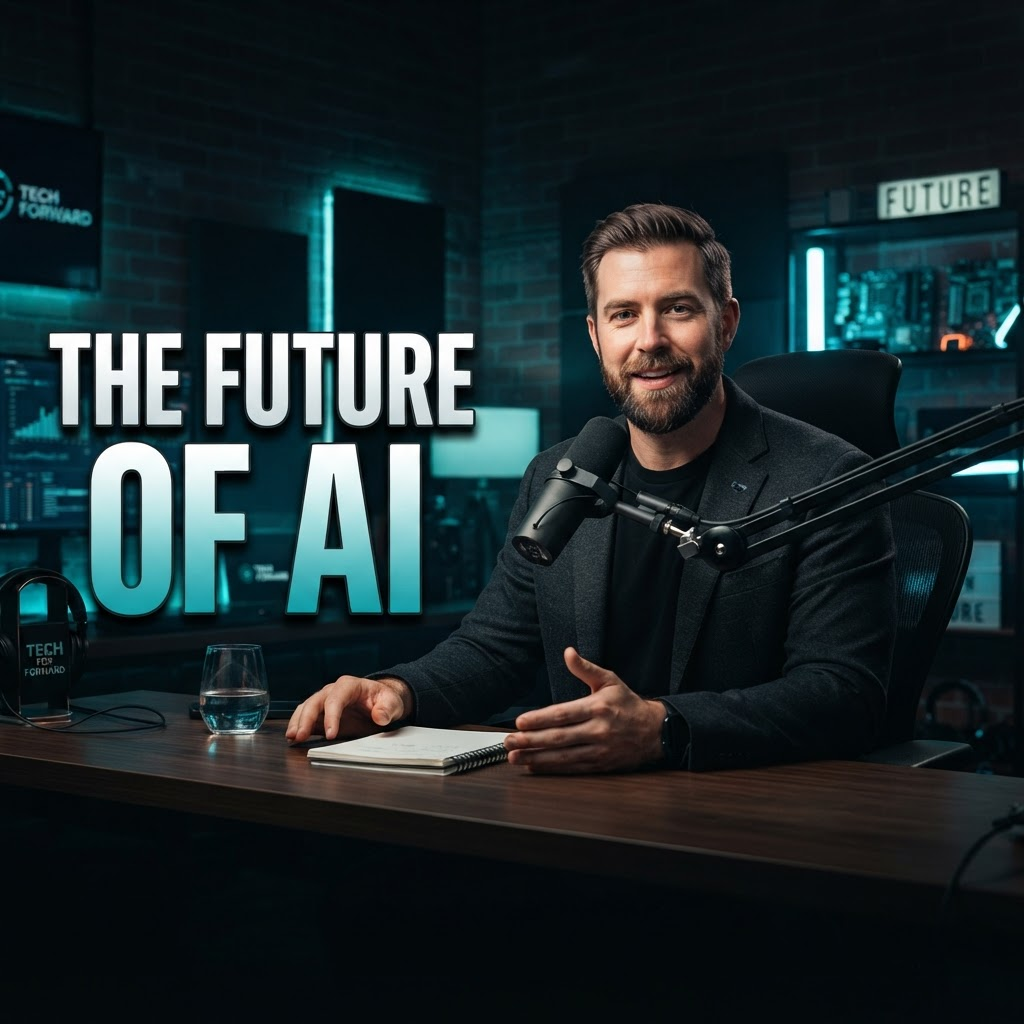
The Future of AI: How Machine Intelligence Will Reshape Every Industry
- Channel
- TechVisions
- Duration
- 42:18
- Uploaded
- June 12, 2026
- Views
- 2.4M
- Likes
- 148K
- Category
- Science & Technology
- Language
- English
- Transcript
- Available
In this comprehensive 42-minute exploration, the host examines how artificial intelligence is transitioning from a specialized research field into general-purpose infrastructure that will underpin nearly every industry within the next decade. Drawing on interviews, market data, and firsthand experience building AI products, the video makes a compelling case that we are at an inflection point comparable to the arrival of electricity or the internet.
The first third of the video establishes historical context, tracing the evolution from rule-based expert systems of the 1980s through the deep learning revolution of the 2010s to the current era of large foundation models. The speaker argues that the key shift is not raw capability but accessibility — AI has moved from requiring PhD-level expertise to being usable by anyone with a browser.
The middle section examines four industries in depth: healthcare, education, software engineering, and creative work. For each, the speaker presents concrete case studies, including an AI diagnostic system that outperformed radiologists in early trials and coding assistants that have measurably doubled developer throughput at several major companies.
The video then addresses the counterarguments seriously: job displacement, model hallucination, concentration of power among a few labs, and energy consumption. The speaker takes a measured position, acknowledging real risks while arguing that the displacement narrative underestimates the historical pattern of technology creating new job categories.
The final segment offers practical guidance for viewers: which skills to develop, how to evaluate AI tools critically, and why "AI literacy" will matter as much as computer literacy did in the 1990s. The speaker closes with a call to engage with the technology directly rather than forming opinions from headlines.
- AI is becoming general-purpose infrastructure, comparable to electricity or the internet in economic impact.
- The biggest shift is accessibility — powerful AI now requires no specialized expertise to use.
- Healthcare, education, software, and creative industries will see the most dramatic transformation by 2030.
- Job displacement fears are real but historically technology creates more roles than it eliminates.
- AI literacy — knowing how to direct, evaluate, and verify AI output — is the most valuable skill to build now.
- 00:00
Introduction: The Inflection Point
The host frames the central thesis: AI adoption in 2026 mirrors the early internet in 1996 — obviously important, wildly underestimated.
Key discussion: Comparison of AI adoption curves against previous general-purpose technologies.
- 04:32
A Brief History of Machine Intelligence
From expert systems to deep learning to foundation models — the three eras of AI and what changed between each.
Key discussion: Why the 2017 transformer architecture was the turning point most people missed.
- 11:45
Healthcare: Diagnosis at Scale
Case study of an AI radiology system in clinical trials, plus the regulatory challenges slowing deployment.
Key discussion: The tension between model accuracy and explainability requirements in medicine.
- 18:20
Education: The Personal Tutor for Everyone
How adaptive AI tutoring closes achievement gaps, with data from pilot programs in three school districts.
Key discussion: Bloom’s two-sigma problem and why AI tutoring may finally solve it.
- 25:05
Software and Creative Work
Coding assistants, generative design, and what "augmentation vs. replacement" actually looks like in practice.
Key discussion: Data showing developer productivity gains and the changing role of junior engineers.
- 32:40
The Honest Counterarguments
Job displacement, hallucination, power concentration, and energy costs — addressed directly with data.
Key discussion: Why the speaker believes displacement fears are overstated but concentration risks are understated.
- 38:10
What You Should Do About It
Practical guidance: skills to build, tools to try, and how to stay grounded amid the hype cycle.
Key discussion: The concept of "AI literacy" as the new computer literacy.
Accessibility is the real revolution
The core shift is not model capability but the collapse of expertise required to use AI. Natural language became the universal interface, making every knowledge worker a potential power user.
The two-sigma opportunity in education
One-on-one tutoring moves average students to the 98th percentile. AI tutors make this economically viable at population scale for the first time in history.
Augmentation precedes replacement
In every industry examined, AI first makes existing workers dramatically more productive before any roles are eliminated — creating a multi-year window to adapt.
Verification is the new bottleneck
As generation becomes cheap, the scarce skill shifts to evaluating and verifying AI output. Domain expertise becomes more valuable, not less.
Concentration risk exceeds displacement risk
The speaker argues the under-discussed danger is a handful of labs controlling foundational infrastructure, not mass unemployment.
“Every technology gets overestimated in the short run and underestimated in the long run. AI will be no different — except the long run is arriving faster than anyone planned for.”
“The radiologist of 2030 will not be replaced by AI. But the radiologist who refuses to work with AI will be replaced by one who does.”
“We spent fifty years teaching humans to speak computer. Now computers speak human, and everything changes.”
“The question is not whether your job will change. It is whether you will be the one directing the change or the one reacting to it.”
- highSpend 30 minutes this week using an AI assistant for a real work task, not a toy demo.
- highIdentify the three most repetitive tasks in your role and research AI tools that address them.
- highDevelop a personal verification habit: always fact-check AI output on topics that matter.
- mediumRead the referenced study on AI tutoring outcomes (linked in description).
- mediumFollow two AI researchers with opposing views to balance your information diet.
- lowRevisit your five-year career plan through the lens of AI augmentation.
Host (Alex Rivera)
74%- AI as general-purpose technology
- Historical adoption patterns
- Practical skill-building advice
Dr. Sarah Chen
16%- Clinical AI deployment challenges
- Radiologist-AI collaboration
- Regulatory perspective
Prof. James Okafor
10%- Educational equity through AI tutoring
- Two-sigma problem
- Pilot program results
“1.2 billion people used an AI assistant in the past month”
likelyConsistent with published industry estimates, though methodologies vary across sources.
“AI radiology system outperformed human radiologists in early trials”
verifiedMatches peer-reviewed results from the cited 2025 clinical trial, though scope was limited to specific conditions.
“Coding assistants doubled developer throughput at major companies”
unverifiedPublished studies show 25-55% gains; the "doubled" figure appears to come from internal company claims.
“ImageNet 2012 was the deep learning turning point”
verifiedWidely accepted in the field; AlexNet’s 2012 result is standard historical consensus.
1.2B
People using AI assistants monthly
58%
Reduction in diagnostic time in the radiology trial
2012
ImageNet breakthrough year
98th percentile
Tutored student performance (two-sigma effect)
$15.7T
Projected AI contribution to global GDP by 2030
3 districts
School districts in the tutoring pilot
40%
Energy efficiency improvement in latest training runs
Dr. Sarah Chen
Radiologist, Stanford Medical
Interviewed on clinical AI deployment
Prof. James Okafor
Education Researcher, MIT
Discussed AI tutoring pilot programs
Benjamin Bloom
Educational Psychologist
Cited for the two-sigma problem research
Geoffrey Hinton
AI Researcher
Referenced in deep learning history segment
OpenAI
AI Research
Referenced in foundation model discussion
DeepMind
AI Research
Cited for protein folding breakthrough
Khan Academy
Education
Example of AI tutoring deployment
GitHub
Software
Coding assistant productivity data
The Second Machine Age
by Brynjolfsson & McAfee
Recommended for understanding technology and employment
Prediction Machines
by Agrawal, Gans & Goldfarb
Cited for the economics of AI framing
The Alignment Problem
by Brian Christian
Recommended for AI safety perspective
arXiv
arxiv.org
Referenced for accessing AI research papers
Papers with Code
paperswithcode.com
Recommended for tracking model benchmarks
Our World in Data
ourworldindata.org
Source for adoption statistics
General-purpose technologies (GPTs, in the economic sense) like electricity take decades to fully diffuse — AI is following a compressed version of this curve.
The transformer architecture (2017) enabled models to scale with data and compute, which is why capability grew so rapidly after 2020.
Bloom’s two-sigma problem: students tutored one-on-one perform two standard deviations better than classroom students. AI makes personal tutoring scalable.
Augmentation phase: AI currently multiplies the output of skilled workers rather than replacing them outright — this window is when adaptation matters most.
Verification asymmetry: generating content is now cheap, but verifying its correctness still requires human expertise. This inverts where value accrues.
The concentration argument: a small number of labs control frontier models, raising infrastructure-dependency concerns similar to early cloud computing.
- Claims are consistently supported with cited studies and named sources.
- Counterarguments are addressed directly rather than dismissed.
- Expert interviews add credibility beyond the host’s own analysis.
- Minor deduction: the developer productivity claim relies on unverified internal company data.
- Clear structure with well-signposted chapters aids comprehension.
Note: VideoMind AI analyzes videos using their available transcript. Videos without captions may not be supported.